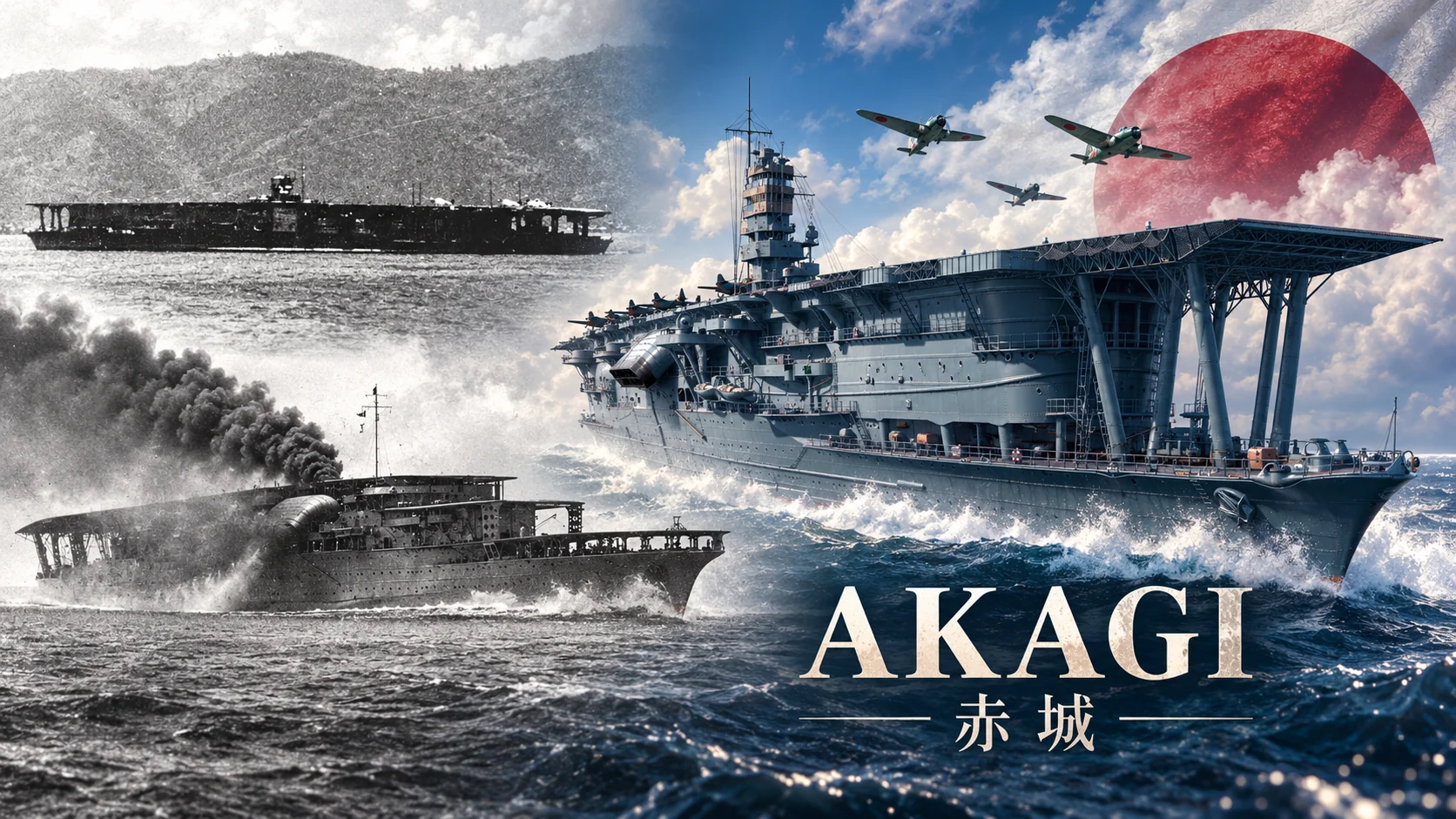
With Akagi, World of Warships is getting one of Japan's best-known aircraft carriers in Update 15.9. The ship initially enters the Supertest as a Tier VIII Premium aircraft carrier and therefore remains Work in Progress.
Together with the American cruiser Honolulu, Akagi is part of the planned web event marking the 85th anniversary of the attack on Pearl Harbor. Players are intended to be able to choose between the two Premium ships as their final reward.
Akagi takes an unusual approach to gameplay. Instead of limiting itself to two or three attack options, it has four different squadrons: regular torpedo bombers, HE skip bombers, tactical torpedo bombers and tactical HE dive bombers.
That sounds very flexible at first. The current test parameters also make a potential problem fairly clear, though: aircraft reserves and restoration times leave little room for error.
From battlecruiser to aircraft carrier
Akagi's story began as an entirely different ship. It was laid down in December 1920 as the second battlecruiser of the Amagi class.
Construction of the class was halted following the Washington Naval Treaty of 1922. Akagi and Amagi were then to be converted into fast aircraft carriers. However, a severe earthquake damaged Amagi's hull so badly that it had to be scrapped. Kaga, originally planned as a battleship, was eventually selected for conversion instead.
Akagi was launched in 1925 and commissioned in 1927. Its original design with three flight decks stacked above one another was particularly distinctive. The idea was to allow aircraft to take off and land simultaneously.
As Japanese carrier doctrine developed, that arrangement proved increasingly unsuitable. Modern aircraft were becoming larger and heavier, while carriers were evolving from support vessels into the Japanese Navy's principal offensive warships.
Akagi therefore underwent a major modernization between 1935 and 1938. The three short flight decks were replaced by a single full-length flight deck, additional hangar space was created, and the distinctive island was built on the port side.
World of Warships depicts Akagi in its 1941 configuration.
Akagi and the Kidō Butai
Before the Second World War, Japan developed a carrier doctrine that deployed several aircraft carriers together to deliver massive, coordinated air strikes.
This led to the Kidō Butai, in which Akagi, alongside Kaga, Hiryū, Sōryū, Shōkaku and Zuikaku, formed a major part of Japan's carrier forces. The approach enabled enormous attack waves but had a crucial drawback: several of the most important carriers were concentrated in the same place, risking correspondingly heavy losses if an enemy attack succeeded.
Akagi became Vice Admiral Chūichi Nagumo's flagship and took part in the attack on Pearl Harbor on December 7, 1941. Its aircraft attacked targets including the battleships Oklahoma, West Virginia, California, Maryland and Pennsylvania, as well as other American ships and installations.
That historical connection is precisely why Akagi is planned to appear alongside Honolulu in the upcoming Pearl Harbor web event.
From Pearl Harbor to the Indian Ocean
After Pearl Harbor, Akagi remained a central part of Japan's carrier forces. In early 1942, it supported operations around Rabaul and Japanese expansion in the Pacific. Attacks on Darwin and support for the invasion of Java followed.
At the end of March, Akagi also took part in the Japanese advance into the Indian Ocean. Aircraft from the Japanese carriers participated in actions including the sinking of the British heavy cruisers Cornwall and Dorsetshire, followed later by the carrier Hermes and other ships.
Only a few months after Pearl Harbor, Japan's carrier fleet appeared to be at the height of its power. That changed at Midway.
Midway becomes Akagi's final battle
In June 1942, the Japanese operation against Midway was intended to force the remaining American carriers into a decisive battle. Akagi sailed with Kaga, Hiryū and Sōryū. Shōkaku and Zuikaku were unable to participate following the Battle of the Coral Sea.
The Japanese believed they held the initiative. In reality, the Americans had deciphered parts of Japan's radio traffic and knew about the planned attack. Enterprise, Yorktown and Hornet were able to position themselves accordingly.
Akagi's situation became particularly critical as Japanese aircraft were repeatedly due to switch between weapons for attacking land targets and torpedoes for use against ships. Several American torpedo bomber attacks were repelled, but further delayed Japanese preparations.
Eventually, dive bombers from USS Enterprise attacked Akagi. Two bombs narrowly missed the carrier, while a third struck the flight deck and exploded in the upper hangar. The resulting fires spread out of control. The crew could no longer contain them, and Akagi had to be abandoned.
The following morning, Japanese destroyers torpedoed the badly damaged carrier on Admiral Yamamoto's orders. Akagi went down along with Kaga, Hiryū and Sōryū. 267 members of Akagi's crew lost their lives. The loss of the four carriers and many experienced crew members made Midway a turning point in the Pacific War.
Akagi's wreck was not rediscovered until 2019. It lies at a depth of around 5,490 meters.
Four squadrons define the gameplay
In World of Warships, Akagi appears in its 1941 configuration with four different squadrons. On paper, that gives it an unusually broad arsenal. The key question is likely to be how efficiently those four tools can be used over an entire battle.
Akagi itself remains a large Japanese carrier
The aircraft carrier currently has 55,200 hit points and 28 percent torpedo damage reduction.
| Parameter | Akagi |
|---|---|
| Tier | VIII |
| Hit points | 55,200 |
| Torpedo protection | 28 % |
| Maximum speed | 31.3 kn |
| Turning circle | 1,170 m |
| Rudder shift time | 14.9 s |
| Detectability by sea | 12.67 km |
| Detectability by air | 10.0 km |
At 31.3 knots, Akagi can certainly reposition. Its 1,170-meter turning circle is a reminder that this is not a particularly nimble carrier, though. The aircraft are more interesting than the hull anyway.
Regular torpedo bombers: high damage, small reserves
The regular torpedo bomber squadron comprises eight B7A Ryūsei. Two aircraft attack each time, so a full squadron theoretically allows four attacks.
| Parameter | B7A Ryūsei |
|---|---|
| Aircraft HP | 1,670 |
| Cruising speed | 137 kn |
| Maximum speed | 177 kn |
| Squadron size | 8 |
| Aircraft per attack | 2 |
| Aircraft on deck | 12 |
| Restoration time | 93 s |
| Torpedoes per aircraft | 1 |
| Torpedo damage | 7,233 |
| Torpedo range | 5.0 km |
| Torpedo speed | 50 kn |
| Flooding probability | 40 % |
With 7,233 damage per torpedo, a successful attack has plenty of potential. The problem comes afterwards: Akagi starts with just twelve of these aircraft on deck and needs 93 seconds to restore a single aircraft.
Anyone who sends squadrons through strong AA early on and regularly loses several aircraft is likely to feel the consequences later in the battle.
HE skip bombers: Akagi's tool against larger targets
The second regular squadron also consists of eight B7A Ryūsei, this time as skip bombers. Four aircraft attack simultaneously, giving a full squadron just two attack waves.
| Parameter | HE skip bombers |
|---|---|
| Aircraft HP | 1,650 |
| Cruising speed | 145 kn |
| Maximum speed | 185 kn |
| Squadron size | 8 |
| Aircraft per attack | 4 |
| Aircraft on deck | 12 |
| Restoration time | 85 s |
| Bomb damage | 8,800 |
| HE penetration | 55 mm |
| Fire chance | 50 % |
| Skips | 2 |
Four bombs with 8,800 potential damage each produce a theoretical 35,200 alpha damage. Add 55 mm of penetration and a 50 percent fire chance per bomb.
Losses are costly here too. The reserve consists of just twelve aircraft.
Tactical torpedo bombers: six torpedoes in one attack
Akagi also gets a tactical squadron of six B6N Tenzan. Unlike the regular torpedo bombers, the entire squadron attacks at once.
| Parameter | Tactical torpedo bombers |
|---|---|
| Aircraft HP | 1,600 |
| Cruising speed | 133 kn |
| Maximum speed | 173 kn |
| Squadron size | 6 |
| Aircraft per attack | 6 |
| Squadron restoration time | 190 s |
| Torpedoes per aircraft | 1 |
| Torpedo damage | 5,400 |
| Torpedo range | 5.0 km |
| Torpedo speed | 50 kn |
| Flooding probability | 30 % |
Each torpedo deals less damage than those of the regular squadron. In return, six torpedoes can be dropped at once. If all six hit, that amounts to a theoretical 32,400 damage before the usual damage calculations.
After that, however, comes the wait: the full squadron needs 190 seconds before it is ready again.
Tactical HE dive bombers with six bombs
The fourth tool consists of six D4Y3 Suisei. This tactical squadron also has only one attack.
| Parameter | Tactical HE dive bombers |
|---|---|
| Aircraft HP | 1,580 |
| Cruising speed | 142 kn |
| Maximum speed | 182 kn |
| Squadron size | 6 |
| Aircraft per attack | 6 |
| Squadron restoration time | 130 s |
| Bomb damage | 8,800 |
| HE penetration | 55 mm |
| Fire chance | 50 % |
Six bombs produce up to 52,800 theoretical alpha damage, although landing every hit will naturally not be the norm.
The more interesting option is to deploy this squadron deliberately after an opponent has used Damage Control Party.
Four squadrons do not automatically mean endless aircraft reserves
Akagi's selection looks comfortable on paper. In practice, though, two different systems operate side by side.
The regular torpedo and skip bombers have conventional reserves. Lost aircraft must be restored individually. The two tactical squadrons each make a single full attack and return only after a fixed countdown.
That creates an interesting resource-management problem. You want to use the regular squadrons efficiently throughout the match. The tactical squadrons can be deployed more aggressively, but are then completely unavailable for 130 or 190 seconds.
More than many other carriers, Akagi is therefore likely to depend on switching sensibly between its four tools.
Aircraft losses could become Akagi's biggest weakness
This is the biggest question mark in the current test version.
The regular aircraft have between 1,650 and 1,670 hit points. The tactical aircraft have even less, at 1,580 and 1,600 HP. Meanwhile, the regular reserves are small.
Akagi could therefore struggle in Tier X battles in particular if its squadrons regularly have to fly through concentrated AA. Heavy losses can only be replaced slowly.
Having four squadron types does not automatically mean enough aircraft will be available at all times.
Akagi could depend on chaining attacks
The concept becomes interesting when all four squadrons are considered together.
For example, Akagi can force fires with HE. If the target then uses Damage Control Party, another HE squadron can try to start fresh fires. Torpedo attacks add direct damage and the possibility of flooding.
Its real strength may therefore lie less in a single outstanding squadron than in timing different attacks to work together.
That only works, however, as long as aircraft losses and the long restoration times are managed carefully.
Akagi or Honolulu will eventually become a real choice
The planned way of obtaining the ship adds significance to the Supertest.
Akagi and the American Tier VII cruiser Honolulu are intended to feature in a web event marking the 85th anniversary of the attack on Pearl Harbor. At the end, players will be able to choose between the two Premium ships.
The test parameters therefore matter for more than simply deciding whether Akagi looks interesting. Eventually, they will inform a concrete choice between two very different ships.
Honolulu currently offers 15 152 mm guns, American smoke, Hydro, Repair Party and unusually strong torpedo protection. Akagi, by contrast, offers the more complex aircraft carrier concept.
It is still too early to decide, however. Both ships remain in testing, and their parameters may change before the event.
Conclusion
Akagi brings back both a major historical name and an unusual carrier concept.
Four different squadrons provide plenty of options on paper. The real challenge is likely to be keeping those options available over the full course of a battle.
The regular torpedo bombers deliver high individual damage, while the skip bombers provide strong HE attacks. Two tactical squadrons each allow a larger single strike, but then face a long wait for restoration.
That combination could make Akagi demanding to play. There is also a risk that small reserves, fragile aircraft and long restoration times will limit the concept too heavily, especially against strong Tier X AA.
We will have to wait and see which parameters are adjusted during the Supertest before release. The current values are Work in Progress, not final ship data.