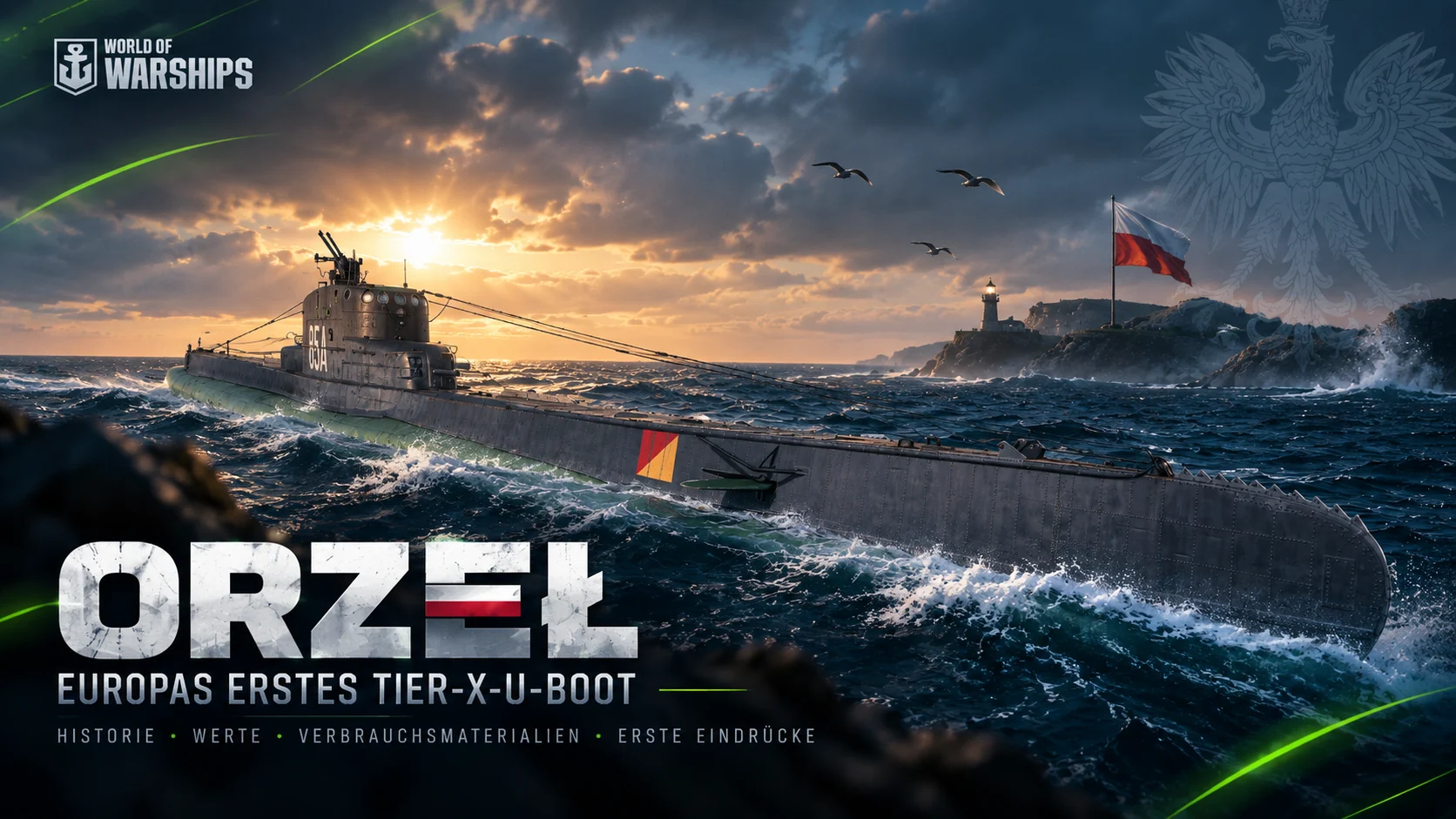
With Orzeł ⚓, another unusual test ship has appeared in World of Warships. The Polish submarine is being tested at Tier X and is also the first submarine of the European nation in the game.
What makes her interesting is less any one absurd torpedo statistic than the overall package. Orzeł gets very good concealment, unusually flexible torpedo launchers, large dive reserves, and a consumable that can temporarily take much of the sting out of enemy anti-submarine attacks.
As always with ships like this, however, one point remains important: Orzeł is still in testing. All values may change before a possible release.
Orzeł brings a new submarine to Europe
Orzeł is currently listed as a European Tier X Premium submarine. Her in-game depiction is based on the historical ship's condition after joining the British forces in 1940.
The basic values published so far are as follows:
| Value | Orzeł |
|---|---|
| Tier | X |
| Hit points | 16,400 |
| Surface speed | 32.0 knots |
| Submerged speed | 16.0 knots |
| Turning circle radius | 460 m |
| Rudder shift time | 5.9 s |
| Surface detectability | 5.2 km |
| Air detectability | 1.9 km |
| Periscope-depth detectability | 1.9 km |
| Dive capacity | 290 units |
| Underwater depletion | 1 unit/s |
| Regeneration | 1.4 units/s |
The 5.2 km base detectability immediately stands out. Combined with the small turning circle and 32 knots on the surface, that gives Orzeł a good foundation for choosing her position and controlling engagements.
Her dive reserve is not exactly small either. With 290 units, she theoretically has 290 seconds, or 4 minutes and 50 seconds, of continuous dive time before modifiers or other factors are taken into account.
Twelve torpedo tubes and rotating launchers
The torpedo layout is one of the ship's more interesting features.
Orzeł has a total of:
- 2 × 2 rotating 550-mm torpedo launchers
- 8 × 1 fixed 550-mm torpedo tubes
The two twin launchers are mounted amidships and can rotate. That gives Orzeł considerably more flexibility in choosing her firing angles than a submarine whose armament points rigidly forward or aft.
The reload time is currently just 50 seconds.
As with other submarines, two different torpedo types are available.
Standard torpedoes
| Value | Standard torpedoes |
|---|---|
| Range | 10.0 km |
| Damage | 17,133 |
| Speed | 69 knots |
| Flooding chance | 105% |
| Detectability | 1.6 km |
These are the slower, unguided torpedoes with considerably higher damage per hit.
Acoustic torpedoes
| Value | Acoustic torpedoes |
|---|---|
| Range | 12.0 km |
| Damage | 7,833 |
| Speed | 89 knots |
| Flooding chance | 31.5% |
| Detectability | 2.4 km |
Here, the relationship is quite different. The acoustic torpedoes travel considerably faster at 86 knots and have two extra kilometers of range, but at 7,833 damage they deal less than half the alpha damage of the standard torpedoes.
Switching between the two torpedo types takes 10 seconds.
Note: the original Supertest dataset still listed 86 knots. The game data we currently have loaded already lists the acoustic torpedoes at 89 knots.
Sonar with a 12 km range
The ASDIC 10 Mod. A sonar also works at up to 12 km.
| Value | Sonar |
|---|---|
| Range | 12.0 km |
| Reload | 6.0 s |
| Ping speed | 500 m/s |
| Ping width | 15 m |
| Marking after one ping | 25 s |
| Marking after two pings | 65 s |
The 500 m/s ping speed is one of the areas where Orzeł does not only gain advantages on paper. At longer distances in particular, the lead needs to be judged accurately.
The ship also has no Hydrophone in the current test version.
The Torpedo Defense System is the most striking feature
The real eye-catcher is in the consumable package.
Alongside Damage Control Party, Submarine Surveillance, and Engine Boost, Orzeł has a Torpedo Defense System.
While this consumable is active, damage taken from torpedoes and depth charges is reduced by 70 percent.
| Torpedo Defense System | Value |
|---|---|
| Charges | 2 |
| Action time | 10 s |
| Cooldown | 180 s |
| Damage from torpedoes and depth charges | -70% |
Ten seconds does not initially sound particularly long. On a submarine, however, those exact ten seconds can be decisive during an enemy ASW attack.
The system is therefore probably the part of the current design most worth watching during testing. It may allow Orzeł to briefly survive mistakes or very aggressive situations that would be considerably more dangerous for other submarines.
With only two charges and a three-minute cooldown, at least the effect cannot be maintained permanently.
Submarine Surveillance and Engine Boost are included too
Orzeł also receives Submarine Surveillance with a range of 6 km.
Preparation takes 330 seconds, after which enemy submarines are detected for 60 seconds. The cooldown is 120 seconds.
Engine Boost has three charges. It increases maximum speed by eight percent for 120 seconds and also has a 120-second cooldown.
That mathematically turns her 32 knots on the surface into around 34.6 knots while the boost is active.
This strongly supports the direction we can already see for the ship: good concealment, high mobility on the surface, and tools for deliberately getting into a favorable position.
And yes, Orzeł really does have a deck gun
The single 105-mm Bofors gun is functional as well.
It fires SAP only:
| Value | 105-mm Bofors |
|---|---|
| Guns | 1 × 1 105 mm |
| Range | 6.0 km |
| Reload | 5.0 s |
| Sigma | 2.0 |
| SAP damage | 2,250 |
| Penetration | 29 mm |
| Muzzle velocity | 850 m/s |
One barrel obviously does not make her a small cruiser. But a functional SAP deck gun on a submarine definitely belongs in the “because we can” category.
The historical Orzeł has quite a wild story
The choice of ship is interesting beyond the gameplay values too.
The historical ORP Orzeł was built in the Netherlands, launched in 1938, and commissioned in February 1939. Just a few months later, she was already in action during the German invasion of Poland.
After suffering damage, with the operation looking increasingly hopeless, Orzeł entered Tallinn in Estonia in September 1939. The ship was supposed to be interned and disarmed there.
The crew had other plans, however.
While the Estonians removed torpedoes and equipment, the crew delayed the work. Among other things, a hoisting cable was sabotaged. Under the pretext of fishing, a crew member secretly measured the depth of the harbor from a small boat.
The escape finally succeeded on the night of September 17–18, 1939.
That was only the beginning. With their navigation charts confiscated, the crew had to find their way using, among other things, a list of lighthouses. Despite damaged communications, Orzeł eventually reached Britain and was later assigned to the Royal Navy's 2nd Submarine Flotilla.
On April 8, 1940, she sank the German troop transport Rio de Janeiro.
On May 23, 1940, Orzeł sailed on her seventh patrol and never returned. On June 11, she was officially reported lost.
To this day, what happened to the submarine has not been conclusively established. The wreck has not been found either.
A small historical detail even appears on the model
Wargaming has apparently included a rather nice detail on the virtual ship as well.
A bronze commemorative plaque is mounted on the port side of the conning tower, just as on the historical ship. Among other things, it commemorates Orzeł's funding through public collections for the Polish Navy.
It is completely irrelevant to gameplay, but exactly the sort of detail worth keeping on a historical ship.
Conclusion
In her current test version, Orzeł looks like an unusually flexible Tier X submarine.
The combination of 5.2 km concealment, 32 knots of surface speed, a 290-second dive reserve, twelve torpedo tubes, and a reload of just 50 seconds already gives her plenty of options on paper.
The rotating twin launchers are particularly interesting. They could make Orzeł less tied to the conventional, rigid forward-and-aft orientation of other submarines.
The biggest eye-catcher remains the Torpedo Defense System, with its 70 percent reduction in damage from torpedoes and depth charges. Testing will have to show whether a ten-second action time and two charges are enough of a limitation.
The package is not without drawbacks. Acoustic torpedoes deal only 7,833 damage, ping speed is 500 m/s, and Hydrophone is entirely absent.
Above all, these numbers should not currently be treated as finished live values. Orzeł is being tested and may still change significantly before release.